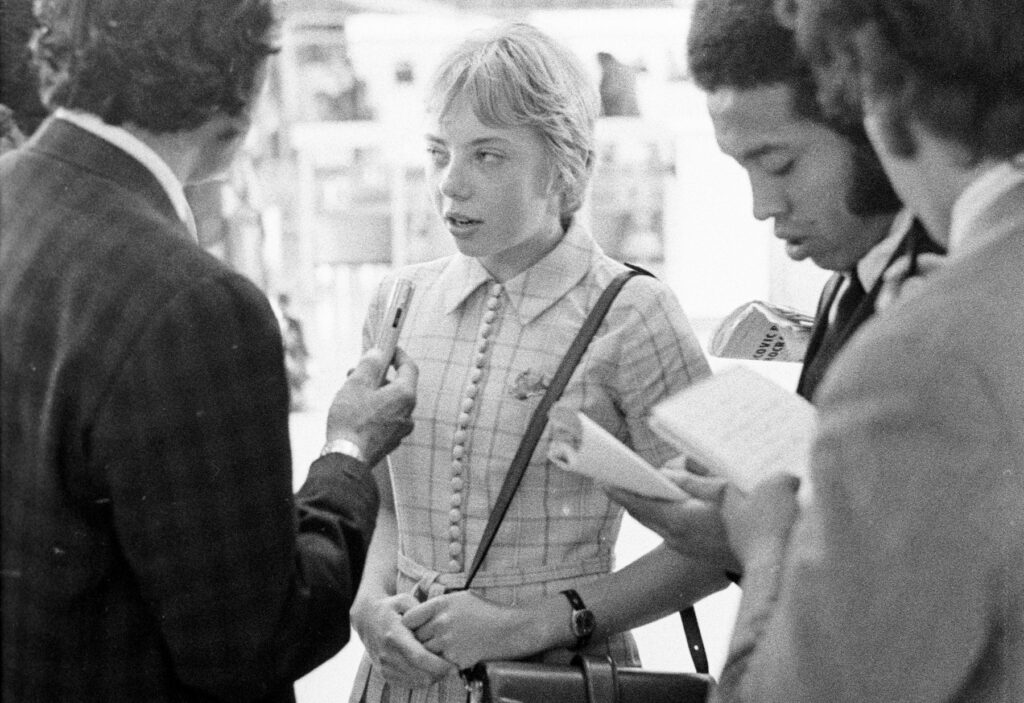
On Christmas Eve of 1971, Juliane Koepcke was traveling with her mother from Lima to Pucallpa. Just prior to landing, the aircraft encountered a fierce storm and crashed into the Peruvian rainforest.
Juliane plummeted roughly 3,000 meters while still secured to a row of three seats. She found herself isolated in the jungle, hurt and without her glasses. At the time, she was 17 years old.
Among the 92 passengers on LANSA Flight 508, she was the sole survivor to emerge from the jungle.
**The Flight that Never Reached Pucallpa**
Juliane was born on October 10, 1954, in Lima. Her parents, Maria and Hans-Wilhelm Koepcke, were German zoologists exploring the flora and fauna of Peru. The family spent extensive periods at the Panguana research station. Juliane had resided there for about a year and a half, learning to identify animal sounds and recognize the forest’s dangers.
On December 24, 1971, she and her mother boarded a Lockheed L-188A Electra to meet Hans-Wilhelm Koepcke at Panguana for the holiday season. Approximately 15 minutes before the designated landing, the plane hit a storm. Juliane observed a flash of light around the right wing. Luggage started to fall, and the plane nosedived. Her mother’s final words were, “This is the end.”
**The Fall from 3,000 Meters**
Juliane’s section of seats detached from the aircraft. She later recalled seeing various shades of green below before losing consciousness. She came to about an hour later, lying in the mud under the three seats. Their rotation during the fall may have slowed her descent, and the tree canopies softened the impact.
Juliane suffered a concussion, a broken collarbone, a knee ligament injury, and a severe cut on her arm. One eye was swollen shut, she had lost her glasses, and she was in only one shoe. Nevertheless, she managed to walk.
**The Lesson That Showed Her the Way**
Close to her landing area, Juliane discovered a bag containing around 30 candies, which became her only solid food for the following 11 days. After a few hours, she heard flowing water and located a small stream concealed within the vegetation.
She recalled her father’s counsel: if you find yourself lost in the jungle, follow the flowing water. The stream will connect to a larger river, and near a river, you will eventually encounter people.
Juliane traced the water’s path. She moved cautiously, placing her shod foot first to avoid thorns, ants, and unveiled creatures. As the stream deepened, she started to let the current guide her.
Above the treetops, she heard planes searching for the wreck, but the foliage was too thick for rescuers to spot her.
**The Boat that Appeared on the Eleventh Day**
After a week, her supply of candies was exhausted. Juliane survived solely on water and grew increasingly frail.
On the eleventh day, Juliane noticed a boat anchored on the riverbank she had been following through the jungle. Initially, she thought it was a mirage, but nearby stood a few hunters and lumberjacks. When the men emerged from the trees, the young girl told them in Spanish who she was and explained her connection to the crash.
The men tended to her injury and transported her to a location where she could receive medical assistance. A few days later, her mother’s remains were discovered.
**Life After the Accident**
Once she recovered, Juliane relocated to Germany, where she pursued biology, concentrating her research on mammals, particularly bats. She advanced her studies to obtain a doctorate, and in 1989, she wed entomologist Erich Diller.
In 1998, she revisited the crash site with filmmaker Werner Herzog, who created the documentary “Wings of Hope” in her honor. Returning to the jungle allowed her to discuss the experience she had tried to distance herself from for years.
After her father passed away, Juliane continued the work her parents initiated at the Panguana research station. Through her and her colleagues’ endeavors, the protected area surrounding the station grew from around 1.8 to 26 square kilometers. The rainforest transformed from just a site of tragedy for her to the habitat that preserved her life, which she chose to safeguard in return.
**Did You Know?**
Juliane Koepcke survived a free fall from roughly 3,000 meters without a parachute, still connected to a row of three seats. Their rotation and the canopy of trees may have slowed her fall and cushioned the landing.
In the 11 days spent in the jungle, her only solid sustenance was a bag containing about 30 candies. Once they ran out,